
Type 2 collagen for joints: UC-II vs hydrolyzed, and the 40 mg question
After 50 Strong reviewed the trials for this guide. Type 2 collagen has a rare claim. In a head-to-head trial, a 40 mg capsule outperformed glucosamine plus chondroitin. But two very different products hide behind the word collagen. The popular powder is the wrong one for joints. Here is how to tell them apart.
- The joint form: undenatured type 2 collagen (UC-II), 40 mg daily, from chicken cartilage.
- Head-to-head result: beat glucosamine plus chondroitin in a 191-person, 180-day trial.
- Timeline: 2 to 3 months. Judge at day 90, not day 14.
- The trap: beauty collagen powders are type 1 and 3, a different supplement entirely.
What UC-II is
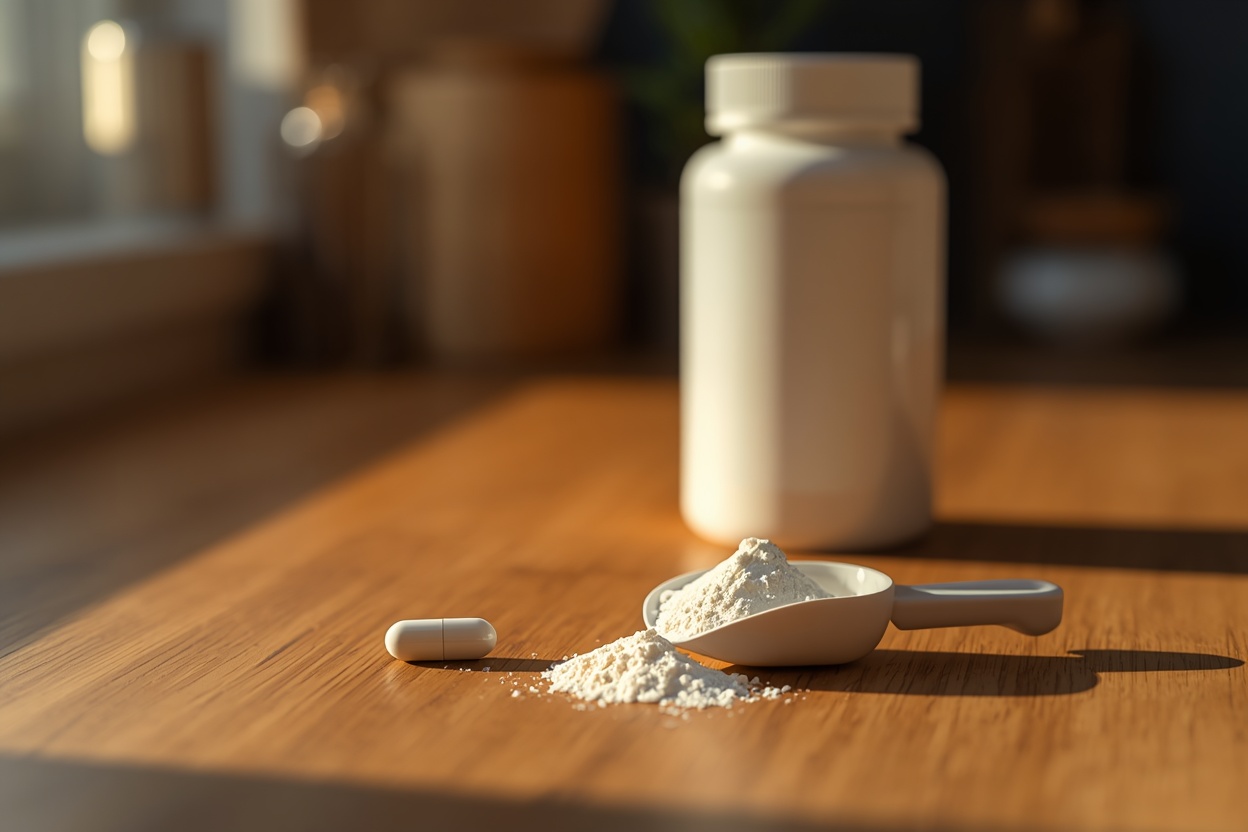
Type 2 collagen is the main structural protein of cartilage. The joint evidence belongs to a specific form. It is called undenatured type 2 collagen, best known by the brand name UC-II. Undenatured means the protein keeps its original shape. The dose is tiny, 40 mg per day, because it does not work as a building block.
Hydrolyzed collagen, also called collagen peptides, is collagen broken into fragments. Powders deliver 8 to 10 grams per serving. Most are type 1 and 3 collagen from cowhide or fish skin. Those fragments supply amino acids. Skin and hair research uses them. Joint cartilage research mostly does not.
Same word, different molecules, doses 250 times apart. Mixing them up is the most expensive mistake in the collagen aisle.
How UC-II works
UC-II’s mechanism surprises most people. Swallowed on an empty stomach, the intact collagen fragment reaches immune tissue in the gut. There it teaches the immune system to tolerate type 2 collagen instead of attacking it. Researchers call the process oral tolerance.
The theory fits osteoarthritis, where low-grade immune activity against cartilage contributes to damage. UC-II does not try to rebuild cartilage with raw material. It tries to calm the friendly fire. That is why 40 mg can do what grams of powder cannot.
What the trials found
Crowley 2009, 52 patients, 90 days. UC-II at 40 mg on an empty stomach at bedtime versus glucosamine 1,500 mg plus chondroitin 1,200 mg. WOMAC scores fell 33% with UC-II. The combination arm fell 14%. Pain on the VAS scale fell 40% versus 15.4%. Function on the Lequesne index improved 20.1% versus 5.9%. Source: Crowley et al., Int J Med Sci, 2009 (PMID 19840193).
Lugo 2016, 191 patients, 180 days. The bigger, stricter test: UC-II versus the glucosamine-chondroitin pair versus placebo. At day 180, total WOMAC fell 551 points with UC-II. The glucosamine-chondroitin pair fell 454 points. Placebo fell 414 points. UC-II beat both. Pain improved 24.0 points versus 17.0 on placebo. Every subscale favored UC-II. Source: Lugo et al., J Int Soc Sports Nutr, 2016 (PMID 26822714).
One detail deserves a spotlight. In Lugo 2016, the glucosamine-chondroitin arm never separated from placebo on any measure. That mirrors the large GAIT trial’s overall result and complicates the simple story that the classic pair always works. Our glucosamine guide and chondroitin guide explain where that pair still holds up.
The honest caveats. A 2023 meta-analysis of 8 trials confirmed UC-II beats placebo on WOMAC and pain, with the clearest gains on walking measures. But UC-II trials are small, several are industry-funded, and one included trial found no difference versus control. The signal is consistent. The certainty is moderate, not ironclad. Source: Kumar et al., Am J Transl Res, 2023 (PMID 37854210).
What about collagen powders for joints
Hydrolyzed collagen has its own data. Benito-Ruiz 2009 used 10 grams daily for 6 months in 250 patients. Trč 2011 compared 10 grams of hydrolyzed collagen against 1.5 grams of glucosamine sulfate over 90 days. Both studies reported favorable results for the collagen group.
A 2023 meta-analysis pooled 4 trials with 507 knee arthritis patients. It found modest pain relief versus placebo. But every included trial had a high risk of bias. Doses, sources and designs varied wildly. Source: Lin et al., J Orthop Surg Res, 2023 (PMID 37717022).
Hydrolyzed collagen may help joints modestly at 8 to 10 grams daily. It is simply not the molecule the strongest joint trials tested, and a flavored beauty powder marketed for skin is not a joint supplement with better packaging.
How to buy the right one
- Look for the word undenatured and the UC-II name. Plain hydrolyzed collagen or collagen peptides on a label mean the powder form, whatever the marketing implies.
- Check for 40 mg. That is the dose in every positive UC-II trial. Less than 40 mg of undenatured type 2 collagen has no direct trial support.
- Take it on an empty stomach. The Crowley protocol used bedtime dosing before sleep, away from food. The immune mechanism depends on the fragment arriving intact.
- Skip blends that hide the dose. A joint complex listing collagen inside a proprietary blend without milligrams tells you nothing.
Safety notes
UC-II’s safety record is clean. Across trials, side effects matched placebo, with occasional mild digestive upset or headache. No drug interactions are documented, which sets UC-II apart from chondroitin and its warfarin warning. UC-II comes from chicken sternum cartilage. Anyone avoiding poultry-derived products should know the source. Pregnancy safety data does not exist.
The bottom line
Among joint ingredients, undenatured type 2 collagen offers the most interesting risk-reward profile right now: a tiny 40 mg dose, a plausible immune mechanism, two positive head-to-head trials, and placebo-level tolerability. The evidence base is still young and partly industry-funded, so confidence is moderate. If you try one collagen for your knees, make it undenatured type 2 at 40 mg, taken at bedtime, judged at 90 days. Everything else on the joint health hub puts that choice in context.
Frequently Asked Questions
What is the difference between UC-II and collagen peptides?
Two different products share the word collagen. UC-II is undenatured type 2 collagen from chicken cartilage. The studied dose is just 40 mg per day. It works through the immune system, not as a building block. Collagen peptides are hydrolyzed collagen. Most are type 1 and 3 from cow or fish skin. The studied dose is 8 to 10 grams per day. They supply amino acids as raw material. Different forms, different doses, different mechanisms.
What is the studied dose of type 2 collagen?
Forty milligrams per day of UC-II is the standard trial dose. Take it on an empty stomach. Bedtime works best. Both key trials, Crowley 2009 and Lugo 2016, used exactly 40 mg. For hydrolyzed collagen peptides, studied doses run 8 to 10 grams per day. The two numbers are not interchangeable.
Is type 2 collagen better than glucosamine and chondroitin?
In head-to-head trials, yes. In Lugo 2016, UC-II at 40 mg beat both placebo and the glucosamine-chondroitin pair. The win was on total WOMAC score over 180 days. Strikingly, the glucosamine-chondroitin arm did not beat placebo at all in that trial. One caveat: UC-II trials are smaller. Several are industry-funded. Independent confirmation would strengthen the case.
How long does type 2 collagen take to work?
Plan on 2 to 3 months. Pain scores separated from placebo around day 60 in the Lugo trial. They kept improving through day 180. Crowley 2009 measured its final results at day 90. A 30-day trial is too short to judge UC-II fairly.
Does a regular collagen powder work for joints?
The evidence is weaker and different. Most collagen powders are hydrolyzed type 1 and 3. They come from cow or fish. The target is skin. A 2023 meta-analysis pooled 4 trials with 507 knee arthritis patients. It found modest pain relief versus placebo. But every included trial had a high risk of bias. Joint-specific data belongs to type 2 collagen, not beauty powders.
What are the side effects of type 2 collagen?
UC-II has been well tolerated in trials. Side effect rates matched placebo. The occasional complaints are mild digestive issues and headache. UC-II is made from chicken cartilage. Anyone who must avoid poultry-derived products should note the source. No drug interactions are documented. There is no safety data for pregnancy.