
Does glucosamine work for joints? What 20 years of trials found
After 50 Strong checked the published studies for this guide. Glucosamine is the most studied joint supplement in the world. The honest answer is split. One form, taken at 1,500 mg per day, has three-year trials behind it. Another form failed its biggest test. This guide walks through both, with the exact numbers, so you can judge any label in under a minute.
- Studied dose: 1,500 mg per day, in every major trial.
- Form that matters: crystalline glucosamine sulfate outperformed the hydrochloride (HCl) form.
- Key finding: in the GAIT trial, glucosamine alone tied placebo; the glucosamine-chondroitin combo helped the moderate-to-severe subgroup, 79.2% versus 54.3% (Clegg et al., N Engl J Med, 2006).
- Safety note: caution with shellfish allergy and poorly controlled diabetes. Tell your doctor if you take warfarin.
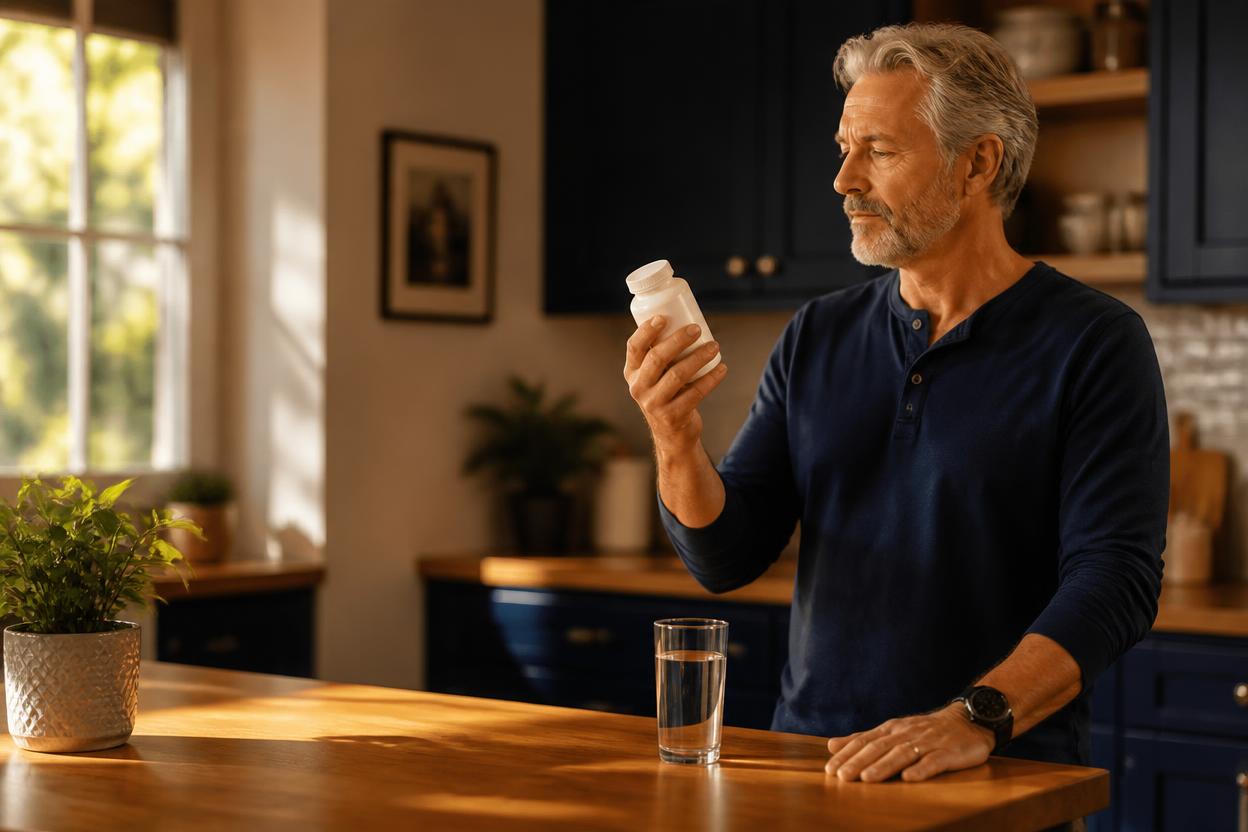
What glucosamine is
Glucosamine is an amino sugar your body makes on its own. It is a building block of cartilage, the cushion between your bones. Production drops with age. Supplements try to top it up.
Most capsules come from shellfish shells. Some newer products are made by fermentation, which matters if you have a shellfish allergy.
How glucosamine is supposed to work
The idea is simple. Cartilage cells use glucosamine to build the molecules that keep cartilage springy. Extra supply could, in theory, slow the wear.
Lab studies support the mechanism. The harder question is whether swallowed glucosamine reaches the joint in useful amounts. That is where the form of the supplement starts to matter.
What the biggest trial actually found
The GAIT trial is the landmark study. It randomized 1,583 patients with knee osteoarthritis across 16 US centers. Average age was 59, and 64% were women. For 24 weeks they took glucosamine 1,500 mg, chondroitin 1,200 mg, both, celecoxib 200 mg, or placebo.
Overall, glucosamine alone did not beat placebo. The response rate was 3.9 percentage points above placebo, well inside chance (P=0.30). Chondroitin alone missed too (P=0.17).
Two results survived. First, the prescription drug celecoxib worked, proving the trial could detect a real effect. Second, in the pre-planned moderate-to-severe pain subgroup (354 patients), the glucosamine-chondroitin combination hit a 79.2% response rate against 54.3% on placebo (P=0.002). Source: Clegg et al., N Engl J Med, 2006.
A two-year GAIT extension followed 662 of the same patients. Over 24 months, no treatment beat placebo on pain or function. Source: Sawitzke et al., Ann Rheum Dis, 2010.
The form question: sulfate versus HCl
Here is the detail most articles miss. GAIT used glucosamine hydrochloride. The positive long-term trials used a different salt: crystalline glucosamine sulfate.
Two three-year European trials of crystalline sulfate, Reginster 2001 and Pavelka 2002, found less knee joint-space narrowing than placebo. A follow-up analysis reported 57% fewer total knee replacements over a five-year period after treatment stopped. Source: Bruyere et al., 2008.
A 2012 review put it bluntly: glucosamine hydrochloride has never outperformed placebo in any study or meta-analysis, while prescription-grade crystalline sulfate has the strongest record. A stratified meta-analysis by Eriksen found pain reduction only in the low-bias trials of crystalline sulfate. Source: Rovati, Ther Adv Musculoskelet Dis, 2012.
The takeaway is not “glucosamine works” or “glucosamine fails.” It is that form, dose and quality decide what you are actually testing.
Dose and forms
The studied range is narrow. Every major trial used 1,500 mg per day.
| Form | Studied daily dose | What trials showed |
|---|---|---|
| Crystalline glucosamine sulfate | 1,500 mg, once daily | Less joint-space narrowing over 3 years (Reginster 2001, Pavelka 2002) |
| Glucosamine hydrochloride (HCl) | 1,500 mg, split as 500 mg three times daily | No benefit over placebo in GAIT, alone or after 2 years |
| Glucosamine + chondroitin sulfate | 1,500 mg + 1,200 mg | Helped only the moderate-to-severe subgroup in GAIT |
Doses up to 3,200 mg per day have been used in trials and were tolerated, but no study shows they work better. Anything above 1,500 mg is beyond the studied range for benefit.
Side effects and safety
Glucosamine has a clean record in trials. Reported issues are mild: stomach upset, heartburn, loose stools. Taking capsules with food helps.
Three groups need extra care:
- Shellfish allergy. Most glucosamine comes from shellfish shells. Reactions appear rare, but fermentation-derived products remove the worry.
- Diabetes. Glucosamine is an amino sugar. Reference monographs advise caution if your blood sugar is poorly controlled. Monitor your readings when you start.
- Warfarin users. Glucosamine may strengthen the effect of warfarin. Tell your doctor before combining them.
Who should skip glucosamine
Skip it if your pain is mild and you expect a quick fix. GAIT showed no benefit over placebo in the mild-pain group. Skip it if you cannot check the form on the label. And skip any bottle that hides the daily dose behind a “proprietary blend.”
Glucosamine versus the alternatives
Glucosamine targets cartilage structure slowly. Chondroitin sulfate works on water retention in the same tissue, which is why trials pair them. Undenatured type 2 collagen takes a different route entirely, training the immune system at just 40 mg per day. MSM supplies sulfur for the same building blocks and is often blended in.
Curious how a real product stacks up? Our JointVive ingredient breakdown checks each dose on its label against these trial numbers.
What to look for on the label
- Form named clearly: glucosamine sulfate, not just “glucosamine.”
- 1,500 mg per daily serving, not per capsule.
- Third-party testing seal, such as USP or NSF.
- Shellfish-free sourcing, if that applies to you.
Frequently Asked Questions
Does glucosamine really work for knee pain?
It depends on the form and on your pain level. In the 1,583-patient GAIT trial, glucosamine hydrochloride at 1,500 mg per day did not beat placebo overall. The glucosamine-plus-chondroitin combination did help patients with moderate-to-severe pain: 79.2% responded versus 54.3% on placebo. European trials of crystalline glucosamine sulfate, a different form, showed better results. Source: Clegg et al., N Engl J Med, 2006.
What is the difference between glucosamine sulfate and glucosamine HCl?
Same base molecule, different salt. Glucosamine sulfate was used in the positive European three-year trials. Glucosamine hydrochloride was used in GAIT and in several trials that found no benefit. A 2012 review noted that hydrochloride has never outperformed placebo in any study or meta-analysis. Source: Rovati, Ther Adv Musculoskelet Dis, 2012.
How long does glucosamine take to work?
The major trials ran 24 weeks to 3 years. Give glucosamine a fair test of 2 to 3 months before judging it. If nothing changes by week 12 at the full 1,500 mg dose, the evidence says it is unlikely to start working later.
Can I take glucosamine if I have diabetes?
Glucosamine is an amino sugar, and early worries about blood sugar have largely faded. Still, official references advise caution for people with poorly controlled diabetes. Tell your doctor you take it, and watch your readings when you start. Source: Drugs.com Natural Products, glucosamine monograph.
Is glucosamine safe with a shellfish allergy?
Most glucosamine is extracted from shellfish shells. The allergy protein lives in the meat, not the shell, so reactions appear rare. If you have a shellfish allergy, look for fermentation-derived glucosamine labeled shellfish-free, and confirm with your doctor first.
Can I combine glucosamine with chondroitin?
That combination is exactly what the GAIT trial tested: 1,500 mg glucosamine plus 1,200 mg chondroitin daily. The combo is where the moderate-to-severe subgroup saw its 79.2% response rate. Many study-grade formulas pair the two for this reason.