
Saw palmetto for prostate: the most popular herb that lost its biggest trials
After 50 Strong checked the saw palmetto evidence, including the trials the marketing prefers to forget. The summary is one of the cleanest in this entire category. Saw palmetto is safe, cheap and famous, and it failed to beat placebo in the New England Journal of Medicine at the standard 320 mg dose, then failed again in JAMA at triple that dose in 369 men followed for 72 weeks. Cochrane reviews say the same across the broader literature: little to no benefit for urinary symptoms. Here is what the trials found, the one 2024 exception that proves standardization matters, the dose studies actually used, and the safety rules that still make sense if you try it anyway.
- Studied dose: 320 mg per day of a liposterolic extract standardized to 85 to 95 percent fatty acids. The JAMA trial pushed to 960 mg and found no added benefit.
- Best trials: no better than placebo for symptom scores, urine flow, prostate size or PSA. Sources: Bent et al., N Engl J Med, 2006; Barry et al., JAMA, 2011.
- The 2024 exception: a phytosterol-enriched saw palmetto extract performed well in one trial, proving the plant can work when standardized properly, and proving nothing about labels that keep standardization private.
- Safety note: clean record. Mild bleeding caution on blood thinners, hormonal-pathway overlap with finasteride and dutasteride, and tell your doctor before any PSA draw.
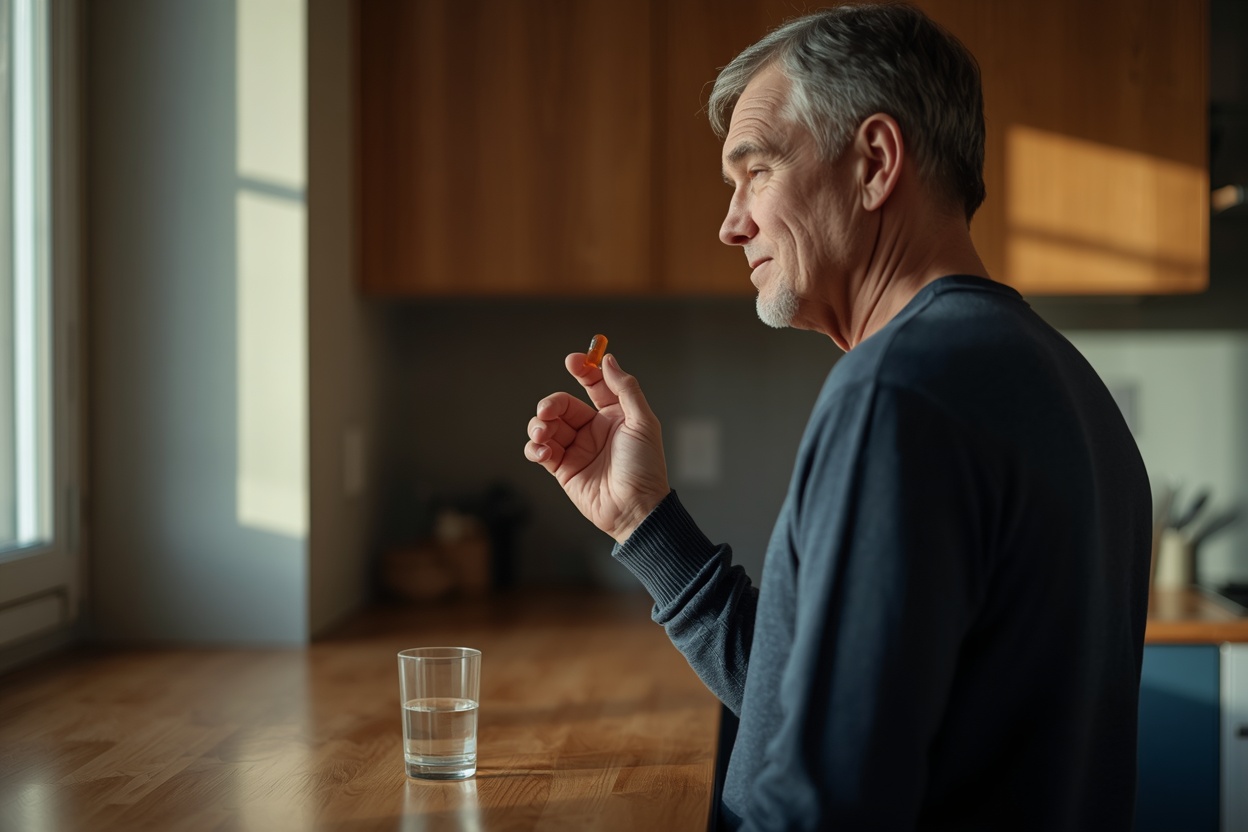
What saw palmetto is
Saw palmetto is a small palm native to the southeastern United States, and the supplement is an extract of its berries. Native American medicine used the plant for urinary complaints, and European phytotherapy adopted it in the twentieth century, where it became the standard herbal prescription for enlarged-prostate symptoms long before the American trials ran. The active fraction is lipophilic: fatty acids and plant sterols, extracted into oil. That chemistry is why the studied form is always an oil-based softgel of standardized extract, never dried berry powder, and why form matters as much as milligrams when a label makes claims.
How it is supposed to work
The proposed mechanism borrows from the prescription drugs. Finasteride and dutasteride shrink prostate tissue by blocking 5-alpha-reductase, the enzyme that converts testosterone into dihydrotestosterone, the form that drives prostate growth. Saw palmetto’s fatty acids have mild, inconsistent activity on the same enzyme in laboratory work, along with anti-inflammatory and anti-proliferative effects in cell studies. A mechanism is a hypothesis with good manners. The trials are what test it, and the mechanism never produced a measurable clinical effect in the two best tests ever run.
What the big trials actually found
The first decisive test came in the New England Journal of Medicine. Bent and colleagues randomized 225 men with moderate enlarged-prostate symptoms to 320 mg per day of a standardized saw palmetto extract or placebo for one year. The result: no significant difference in symptom scores, peak urine flow, prostate size or PSA between the groups. Source: Bent et al., N Engl J Med, 2006.
The second test removed the remaining escape hatch. If the standard dose was too low, a higher dose might work, so Barry and colleagues ran a dose-escalation trial in JAMA: 369 men, 72 weeks, doses climbing to 960 mg per day, triple the standard. Symptoms improved on both arms and essentially identically; on the standard American Urological Association symptom score, the saw palmetto group improved 2.20 points against 2.99 on placebo, with the difference favoring placebo. Higher dose, longer duration, same answer. Source: Barry et al., JAMA, 2011.
Cochrane reviews, which pool the full literature rather than single trials, reach the same conclusion: saw palmetto provides little or no benefit for urinary symptoms from enlarged prostate. The honest modern exception came in 2024, when a trial of a phytosterol-enriched saw palmetto extract reported meaningful symptom improvement. That result does not rescue the average bottle. It indicts it: the plant clearly contains something useful, but it only shows up when the extract is standardized to carry it, which is precisely the information most labels, including the one in our ProstaDefend ingredient audit, decline to print.
Dose and forms
| Form | Studied amount | What evidence says |
|---|---|---|
| Liposterolic extract, 85 to 95% fatty acids, softgel | 320 mg per day | The dose in the major trials; no benefit over placebo |
| Same extract, escalated | Up to 960 mg per day, 72 weeks | No added benefit; placebo improved slightly more |
| Dried berry powder | Varies widely | Not the studied form; cannot borrow softgel-trial evidence |
Side effects and safety
The safety record is the best thing about saw palmetto, and it is genuinely good. In the year-long New England Journal trial, side effects matched placebo almost exactly, and serious harm across the literature is rare. The routine cautions: mild stomach upset or dizziness in a small share of users; a mild additive bleeding tendency that matters on warfarin, aspirin and other blood thinners; mild hormonal-pathway overlap with finasteride and dutasteride that your prescriber should know about; and the standing advice to pause supplements before surgery, with timing set by the surgical team rather than the bottle.
One caution outranks the rest for men over 50: the PSA conversation. Saw palmetto can modestly lower PSA levels in some men, and the NIH National Center for Complementary and Integrative Health advises telling your doctor you take it before any PSA test so the result can be read in context. Sequence matters here. Baseline PSA first, saw palmetto second, if at all.
Who should skip saw palmetto
Skip it if your symptoms are undiagnosed. New weak stream, nighttime trips or incomplete emptying after 50 are reasons to see a doctor, not reasons to self-medicate, and starting saw palmetto before the PSA draw can complicate the very evaluation you need. Skip it on blood thinners without clearance, before surgery without disclosure, and alongside finasteride or dutasteride without your prescriber’s awareness. Skip it if your expectation is structural: no trial shows saw palmetto shrinks prostates, and the tools that do, prescription alpha-blockers and 5-alpha-reductase inhibitors, sit one rung up the ladder with a clinician attached.
Saw palmetto versus the alternatives
Within the botanical category, beta-sitosterol carries the most consistent short-term symptom-relief signal, and pygeum follows with older supportive trials, both at low evidence quality. Saw palmetto ranks below both on the evidence ledger despite ranking far above them on the shelf. Against prescription medicine, there is no contest for moderate symptoms: alpha-blockers relax the muscle around the urethra within days, and 5-alpha-reductase inhibitors shrink tissue over months. Supplements occupy the soft end of that ladder. Our prostate supplements guide maps the whole hierarchy honestly.
What to look for on the label
- 320 mg of liposterolic extract per daily serving, standardized to 85 to 95 percent fatty acids, in an oil-based softgel.
- An actual standardization percentage. Without it, the 2024 positive trial is not evidence for the bottle, only for the extract it used.
- Third-party testing, since fatty-acid content in untested products has a documented history of coming in short.
- No powder-form bait-and-switch: berry powder capsules are a different product wearing the same name.
Frequently Asked Questions
Does saw palmetto really work for the prostate?
The best trials say no. In the New England Journal of Medicine, 225 men with enlarged-prostate symptoms took 320 mg of standardized saw palmetto extract or placebo for one year: symptom scores, urine flow, prostate size and PSA all failed to separate from placebo. The question was pushed again in JAMA with 369 men and a dose escalated to 960 mg per day over 72 weeks, and the result held: no better than placebo, with the placebo group improving slightly more on the standard symptom score. Cochrane reviews reach the same conclusion across the broader literature: little to no benefit for urinary symptoms. Sources: Bent et al., N Engl J Med, 2006; Barry et al., JAMA, 2011.
Why do men still take saw palmetto if the trials failed?
Three honest reasons. It is safe and cheap, so the barrier to a personal experiment is low. Some men report subjective improvement, and with a condition whose symptoms fluctuate naturally, it is genuinely hard for an individual to tell the herb’s effect from the calendar’s. And the marketing never stopped: shelves, ads and word of memory keep the 1990s reputation alive long after the 2000s trials closed the question. If you try it anyway, do it the scientific way: one 320 mg standardized softgel daily, a symptom score at the start, and an honest verdict at 12 weeks. The trial record suggests what the verdict will be, but the experiment is yours and it is harmless.
What dose of saw palmetto do studies use?
The studied dose is 320 mg per day of a liposterolic extract standardized to 85 to 95 percent fatty acids, usually as one softgel. That is the amount used in the major trials, including the JAMA trial that pushed further and found no added benefit at 960 mg per day, so more is not better by any evidence. The form matters as much as the number: the trials used fatty extracts in oil-based softgels, not dried berry powder, whose active content varies enormously. A bottle of berry powder capsules cannot borrow evidence from softgel trials no matter what the front label says.
Can saw palmetto affect my PSA test?
Possibly, and this matters more than any side effect. Saw palmetto can modestly lower PSA levels, which means a result taken while you use it may read lower than your untreated baseline, not because the prostate improved but because the herb is in the bloodstream. In the major one-year trial, PSA itself did not change on saw palmetto, but the clinical advice stands across references including the NIH National Center for Complementary and Integrative Health: tell your doctor you take it before any PSA draw, so the number can be interpreted in context. The practical rule for men over 50: baseline PSA first, saw palmetto second, if at all.
Is saw palmetto safe?
Yes, with one of the cleanest safety records among herbal supplements. The year-long trial reported side effects essentially identical to placebo, and serious harm is rare. The cautions are routine: mild stomach upset or dizziness in a small share of users; a mild additive bleeding tendency relevant if you take warfarin, aspirin or another blood thinner; mild activity on the same hormonal pathway as finasteride and dutasteride, which your prescriber should know about; and the standard advice to pause supplements before surgery and let the surgical team set the timing. Saw palmetto is not the problem in most prostate formulas. The problem is usually everything the label does not say around it.
Who should skip saw palmetto?
Skip it if your urinary symptoms are new and undiagnosed: weak stream, nighttime trips and incomplete emptying after 50 deserve an examination and a PSA conversation first, and starting saw palmetto before the blood draw can muddy the very test that conversation relies on. Skip it on blood thinners unless your doctor clears it, and mention it before any surgery. Skip it alongside finasteride or dutasteride without your prescriber’s awareness, since the pathways overlap. And skip it if your expectation is a smaller prostate or a restored stream: the evidence supports neither, and the tools that address those goals, prescription alpha-blockers and 5-alpha-reductase inhibitors, live one rung up the ladder with your doctor.