
TonicGreens ingredients: an audit the label finishes for us
After 50 Strong audited every TonicGreens ingredient section against the human trials. The audit reaches its verdict through arithmetic rather than opinion. The label’s own blend totals close the question: ashwagandha trials use 300 to 600 mg, inside a 1,000 mg blend shared nine ways. Curcumin trials use hundreds to thousands of milligrams, inside the same blend. Fiber studies use grams; the label offers 350 mg. Probiotics are dosed in billions of colony-forming units; the label offers 22.5 mg of a premix with no colony counts. And the two ingredients the marketing names most prominently, quercetin and resveratrol, do not appear on the panel at all. Here is each section of the verified label, its studied counterparts, and what the arithmetic leaves standing.
- Cannot verify, all sections: per-ingredient amounts are undisclosed throughout, so no component can be confirmed at a studied dose.
- The arithmetic: the entire nine-ingredient herbal blend totals 1,000 mg, a theoretical maximum near 111 mg per ingredient split evenly, against trial doses of 300 to 600 mg for ashwagandha alone.
- Absent by name: quercetin and resveratrol, the marketing’s two scientific pillars, appear nowhere on the four-section panel.
- Food powders, honestly framed: the 21-ingredient superfood blend averages under 150 mg per ingredient, garnish territory, nutritious as a habit and unmeasurable as a dose.
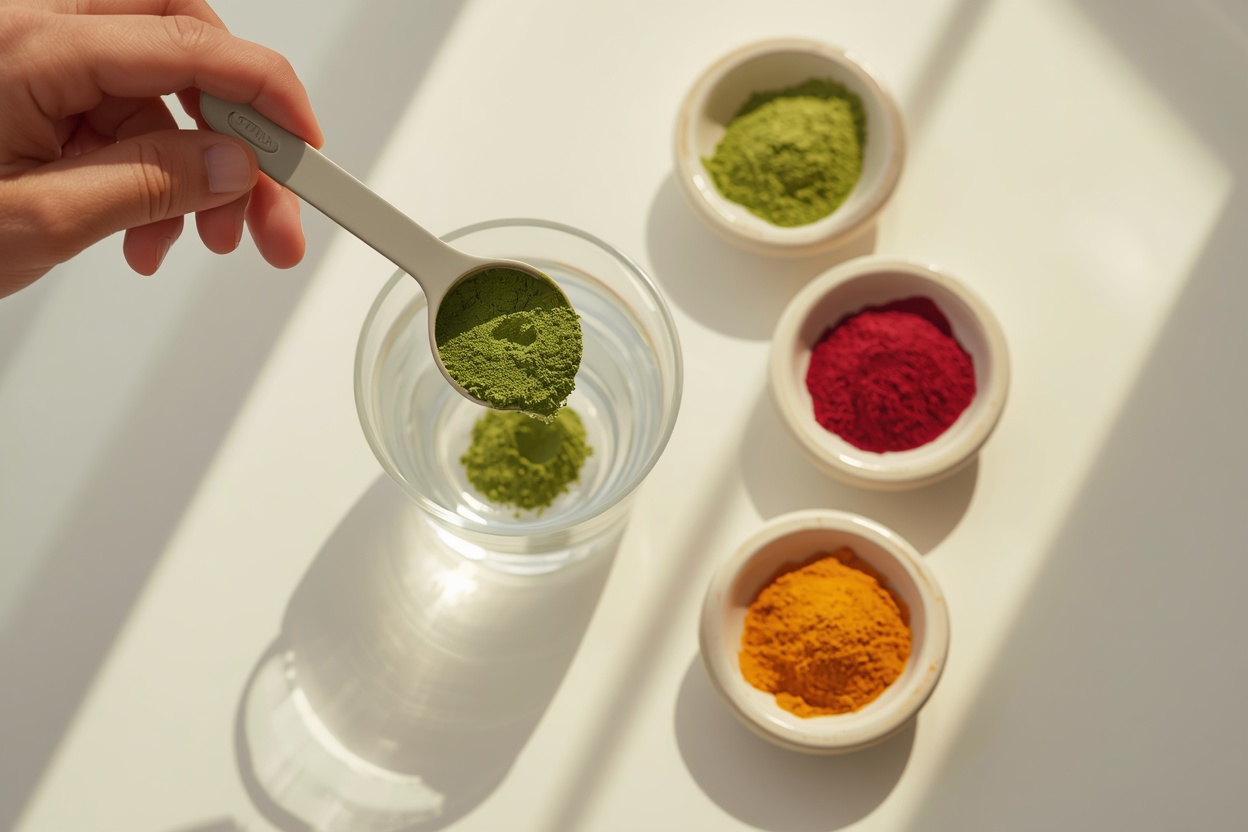
The dose audit, section by section
| Label section | What trials use | The arithmetic | Verdict |
|---|---|---|---|
| 3,000 mg superfood, antioxidant and mushroom blend, 21 ingredients | Diets of whole vegetables carry the evidence; no trial defines an immune dose for these powders as a blend | Under 150 mg per ingredient on average; mushrooms sit at the end of the weight-ordered list | Cannot verify; a greens habit, not a studied intervention |
| 1,000 mg herbs and extracts blend, 9 ingredients, including 10:1 turmeric and ashwagandha | Ashwagandha trials: 300 to 600 mg. Curcumin trials: hundreds to thousands of mg. Green tea extract studies: hundreds of mg | Nine ingredients share 1,000 mg; even split caps each near 111 mg, and the real split is undisclosed | Cannot verify; trial-backed names at fractions of trial doses |
| 350 mg apple fruit fiber | Fiber studies dose by the gram, typically 3 to 10 g per day | 350 mg is one-tenth of the low end of studied ranges | Filler by the standards of its own category |
| 22.5 mg three-strain probiotic premix | Probiotic trials count billions of colony-forming units per strain | No colony counts disclosed; milligrams of a premix cannot be converted | Cannot evaluate, by its own category’s math |
Section by section: what the research says
The superfood blend: a salad, dehydrated
The 21-ingredient blend lists recognizable food powders in descending weight order, alfalfa, carrot, asparagus, beet, berries, broccoli, brussels sprout, camu camu, cauliflower, celery seed, cranberry, cucumber, green bell pepper, kale, maitake, parsley, pineapple, pomegranate, raspberry and reishi. Nothing here is harmful, and several are genuinely nutritious foods. But the evidence for vegetables belongs to eating them, in portions measured in cups, across years of diet. Dehydrated into a blend where the largest single ingredient cannot exceed 3,000 mg and the smallest may be a dusting, this section delivers the aesthetics of a salad without its quantity. The mushrooms are the telling detail: maitake and reishi carry the most supplement-flavored reputations on the list, and they sit at the very end of a weight-ordered list, where the smallest amounts live.
The herbal blend: trial-backed names, garnish-level shares
This is the section where the label flirts with evidence and the arithmetic declines. Ashwagandha has real trials at 300 to 600 mg for stress and sleep, not immunity. Turmeric arrives as a 10:1 extract, the one standardization the panel discloses, yet curcumin trials use hundreds to thousands of milligrams of a compound that is only a fraction of any turmeric preparation. Green tea, ginger and eleuthero all carry mild literature of their own, all at doses the blend cannot supply. Nine names, one thousand milligrams: the label borrows every reputation and funds none of them. Our honest benchmark for what trial-dosed immune support looks like starts in the vitamin D guide, where the doses and the blood levels are both measurable.
The fiber and the probiotic: underdosed by their own standards
Apple fiber at 350 mg against fiber research that works in grams is not a gray area; it is an order of magnitude. The probiotic premix at 22.5 mg without colony counts cannot even be expressed in the units its own field uses. These two sections are the least harmful and the least serious on the panel: they signal the formula’s priorities, which run toward label length rather than label accuracy.
What the label leaves out
The omissions, collected. Per-ingredient milligrams for every blend, without which no trial comparison starts. Colony-forming unit counts for the probiotics, without which the section is decorative. Quercetin and resveratrol, marketed as functional pillars, present at zero milligrams. Any certifying body behind the certified-organic claim. And third-party testing of any kind, the mechanism by which a buyer checks that even the disclosed blend totals are true. Five omissions, and the fifth is the one that audits the other four.
The bottom line on the label
Audit result. Zero ingredients confirmed at studied doses, for the structural reason that zero per-ingredient doses are published. Zero of the two marketed scientific pillars present in the jar. Every trial-backed name in the herbal blend funded at a fraction of its evidence. The label’s blend-level disclosure earns TonicGreens real credit against its niche, and the arithmetic inside those blends spends it. What remains is a pleasant greens habit priced as an immune intervention, wearing the costume of the compounds it does not contain. For what that means in price and practice, see our full TonicGreens review and the safety guide. For immune support with measurable doses behind it, the honest shortlist starts elsewhere.
Frequently Asked Questions
What are the active ingredients in TonicGreens?
The verified label discloses four sections per 4.4 gram scoop: a 3,000 mg proprietary superfood, antioxidant and mushroom blend of 21 ingredients, led by alfalfa, carrot and beet with maitake and reishi mushrooms at the end of the weight-ordered list; a 1,000 mg herbs and extracts blend of nine, including a 10:1 turmeric extract, ashwagandha root, green tea, ginger and eleuthero; 350 mg of apple fruit fiber; and a 22.5 mg three-strain probiotic premix of Lactobacillus reuteri, Bacillus coagulans and Lactobacillus acidophilus. Per-ingredient amounts within the blends are not disclosed. The two ingredients the marketing names most prominently, quercetin and resveratrol, do not appear anywhere on the panel.
Is TonicGreens dosed like the human trials?
Nothing on the label can be confirmed as trial-dosed, and the blend arithmetic explains why before any opinion is needed. Ashwagandha trials use 300 to 600 mg; the entire nine-ingredient herbal blend shares 1,000 mg, leaving a theoretical maximum around 111 mg per ingredient if split evenly, and the actual split is undisclosed. Curcumin trials use hundreds to thousands of milligrams; turmeric is one of nine in the same blend. Fiber studies use grams; the apple fiber section offers 350 mg. Probiotic studies count billions of colony-forming units; the label offers 22.5 mg of a premix with no colony counts at all. The 21-ingredient superfood blend has no trial-defined dose for immune effects as a blend or as individual food powders at these amounts. A scoop can be a pleasant glass of green. It cannot, on this label, be a studied dose of anything.
Which TonicGreens ingredients are filler?
Filler has a precise meaning here: ingredients occupying label space and price weight without a studied immune effect at the amounts present. By that definition, most of the panel qualifies, gently. The 21 food powders are ordinary vegetables and fruits whose health evidence belongs to diets, not scoops, and whose amounts per ingredient average under 150 mg inside the blend. The fiber and probiotic sections are underdosed by the standards of their own categories. The herbal blend carries the only trial-backed names on the panel, ashwagandha, turmeric and green tea, at fractions of studied doses. None of this is harmful, and food powders are not a scam. But an immune supplement whose every ingredient is present below, at or around the level of a garnish is a greens habit with an immune costume.
Why are quercetin and resveratrol in the marketing but not on the label?
Because they are the two names in the pitch with real scientific pedigrees, and their absence is the most instructive fact about how TonicGreens is sold. Quercetin has immune-related trials at 500 to 1,000 mg. Resveratrol carries a famous research literature. The marketing builds six functional groups around them. The verified four-section panel contains neither compound, in any amount. The pattern this creates is worth naming plainly: credibility borrowed from compounds the jar does not contain, extended to a formula that cannot be dosed against any trial, priced as though both were inside. Until the panel lists them with milligrams, the accurate summary of the quercetin and resveratrol content of TonicGreens is zero.
What is missing from the TonicGreens label?
Four things, each decisive for an immune supplement. Per-ingredient milligram amounts inside the blends, without which no trial comparison can start. Colony-forming unit counts for the probiotic section, without which the 22.5 mg premix cannot be evaluated even by its own category’s standards. Quercetin and resveratrol, the two compounds the marketing names most prominently, in any amount. And any certification backing the certified-organic claim, which the label does not carry. A panel missing all four tells you the identity of a formula while declining its measurement. For a product priced as an immune intervention, the missing column is the product.
What should I check on my TonicGreens container?
Four checks against the container in your hand, in order. Match the panel against the four-section structure this page documents: 3,000 mg superfood blend, 1,000 mg herbal blend, 350 mg apple fiber, 22.5 mg probiotic premix, since formula revisions happen silently in this niche. Read every milligram against the studied doses in our ingredient guides: ashwagandha at 300 to 600 mg, curcumin trials in the hundreds to thousands of milligrams, fiber by the gram, probiotics by the billion. Look for quercetin and resveratrol on the panel, since their presence or absence is the fastest audit in this category. And bring the container to your doctor if you take blood thinners, thyroid medication, sedatives or anything else the vitamin K and herbal fractions can touch. The scoop is in your kitchen. The arithmetic is on this page.